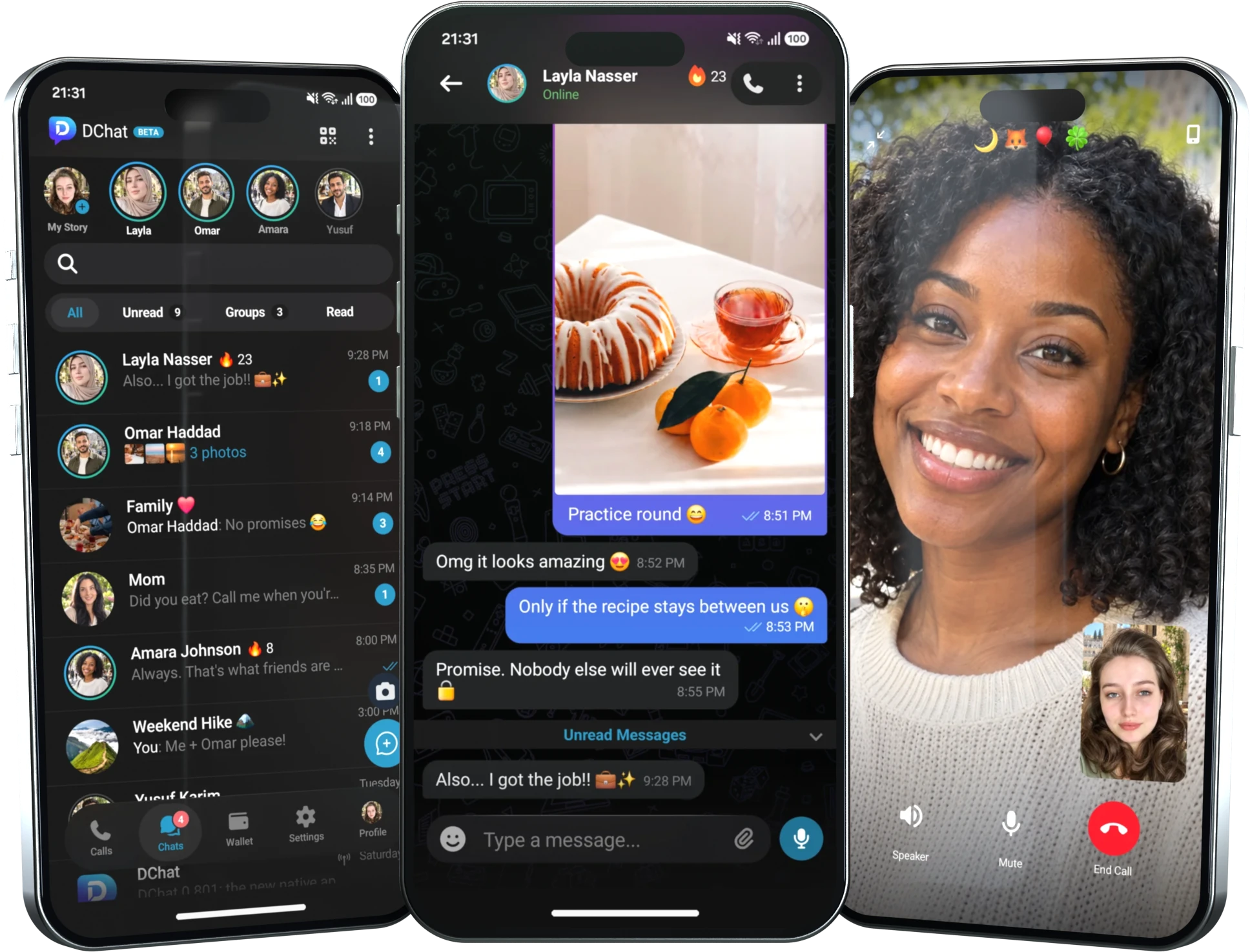
Every DChat message was already encrypted on your phone before it left. What changes today is how strong that lock is, how long each key lives, and what happens if someone ever gets hold of one. The short answer: much stronger, one message, and very little.
The short version
- Every message gets its own key, and the key is thrown away once it is used. Stealing a key today does not open your old messages.
- Your chats heal themselves. If a phone's keys were ever stolen, the next messages lock the thief out again, without you doing anything.
- Quantum-safe key exchange. Your chats and groups use ML-KEM-1024, a post-quantum algorithm, so messages recorded today stay closed even when quantum computers arrive.
- Proven standards, checked to the byte. One-to-one chats use PQXDH and the Double Ratchet, matched byte for byte against the reference implementation. Groups use MLS with ML-KEM-1024, checked the same way.
- Group calls are end-to-end encrypted, and one call now holds up to 200 people.
- Each of your devices has its own keys. Linking a phone or a computer no longer copies your keys anywhere.
Your one-to-one chats
Chats with one person now use PQXDH and the Double Ratchet, the most studied way to protect a conversation between two people. We wrote our own version and then tested it the hard way: we recorded a whole conversation of 367 messages made by the reference implementation and checked that DChat produces exactly the same bytes, every one of them.
Two things come with it that matter to you. Every message is sealed with a fresh key that is deleted right after, so there is no master key that opens your history. And if a device ever loses its keys or gets out of step, for example after you restore an old backup, DChat asks the other side to send again and starts a new, clean session on its own.
Your groups
Groups now use MLS, short for Messaging Layer Security, the open standard built for encrypting groups. Each change in a group, someone joining, someone leaving, a device removed, moves the whole group to new keys.
- Someone who joins cannot read what was said before they arrived.
- Someone who leaves or is removed cannot read anything said after.
- Photos and files in the group each get their own key.
The group algorithms are ML-KEM-1024 with P-384 and AES-256, and we checked our code byte for byte against an independent implementation of the same suite. It is a combination experienced cryptographers already reviewed, not one we invented.
Ready for quantum computers
Someone who records encrypted traffic today could, in principle, keep it until a quantum computer is strong enough to open it. People call this "harvest now, decrypt later". E2EE v2 shuts that door for your messages: the keys for your chats and groups are agreed with ML-KEM-1024, a post-quantum algorithm standardized by NIST at its highest security level, combined with a classic one. An attacker would have to break both.
The certificates that vouch for your devices are signed with ML-DSA-87, a post-quantum signature, so nobody can sneak a fake device into your account. The whitepaper shows where each post-quantum algorithm sits.
Your devices and your account
Before, linking a new phone or a computer meant copying your account's keys to it. Now each device makes its own keys and never shares them. Your account vouches for each device with a signed certificate, and the list of your devices is anchored on the DChat chain, so the network cannot quietly add a device to your account or hide one from your contacts.
Your account also gets a new kind of ID, made from your keys instead of your username. You will not notice it in the app: people still find you by your username. But it means your username can become just a name that points to you.
Your calls
One-to-one calls are set up inside your new encrypted chat, and the call itself stays end-to-end encrypted with an emoji check you can compare.
The big one is group calls. Before, the server that passes the video along could decrypt it. Now group calls are end-to-end encrypted: your phone encrypts every frame with keys that come from the group's encryption, and the server forwards frames it cannot open. And they are bigger: one group call now holds up to 200 people, up from 25.
What you need to do
Nothing, except update the app. A chat switches to E2EE v2 by itself once both of you are on the new version, and a group switches when everyone in it is. Once a chat has moved, it stays on E2EE v2.
Your sender, sealed
Encryption hides what you say. Sealed sender hides who is saying it. With E2EE v2, every message you send to someone is sealed so that the relays carrying it cannot see which account it came from. Only the person you wrote to can open the seal and see that it was you. The seal is checked byte for byte against the reference implementation, like the rest of E2EE v2.
Where to go next
For the details, the E2EE v2 security whitepaper covers every part. The technical deep dive explains how we built and checked it, and what relays can and cannot see covers the part encryption alone does not solve.
